
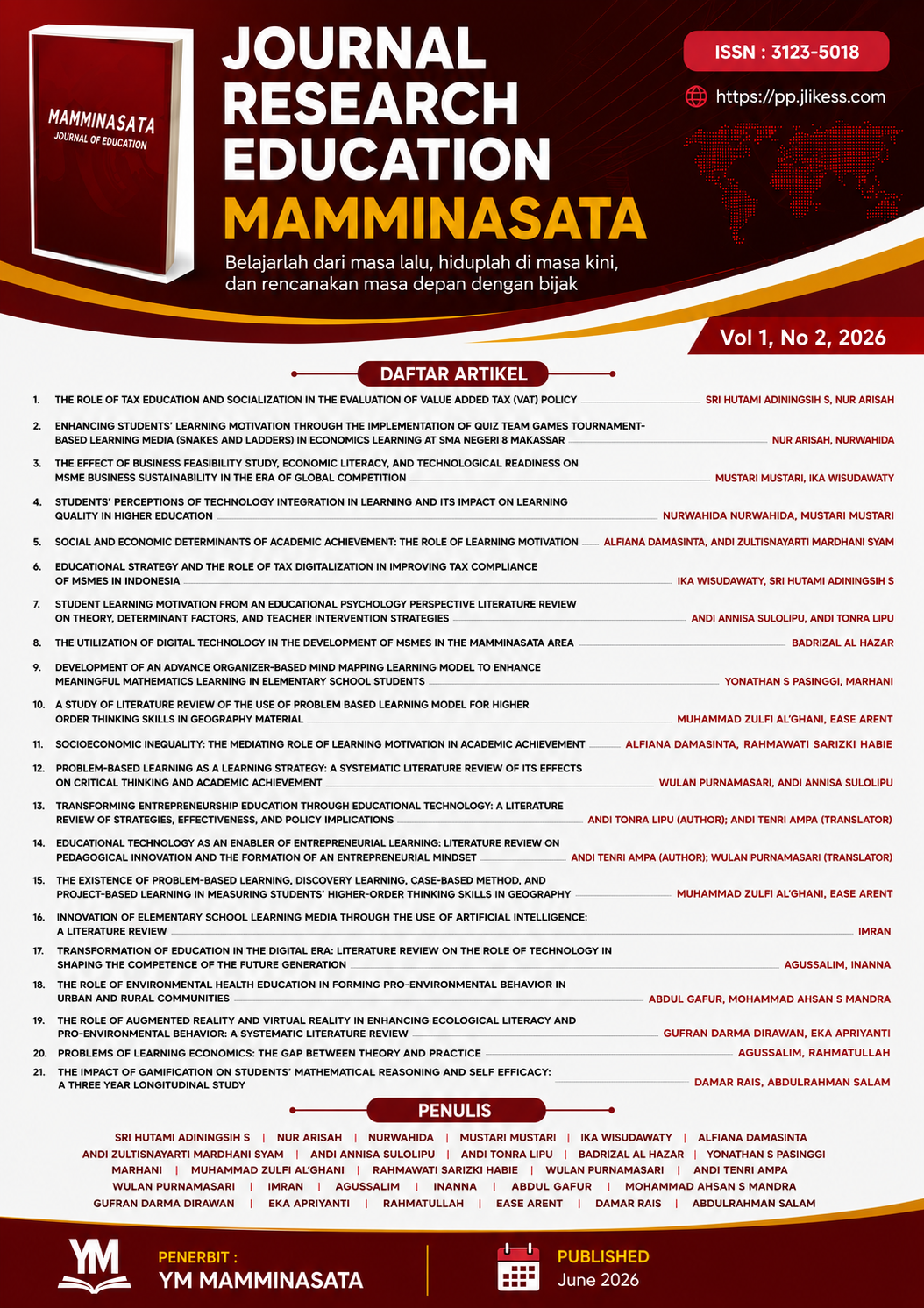
PROBLEMS OF LEARNING ECONOMICS: THE GAP BETWEEN THEORY AND PRACTICE
DOI:
https://doi.org/10.66303/27t0rn88Keywords:
Learning, Economics, Inequality , Theory PracticeAbstract
Economics learning at the senior high school level faces a fundamental problem in the form of a gap between theoretical and applied approaches, which impacts the overall low economic competence of students. This study aims to explore three main dimensions of the problem: the multidimensional factors underlying and perpetuating the theory-practice gap, the impact of the gap on student competence across cognitive, affective, and psychomotor dimensions, and alternative pedagogical strategies and models that have the potential to bridge the gap within the Indonesian education context. The method employed is a systematic literature review, databases covering the period 2020–2025, analyzed using content analysis and narrative synthesis techniques. The findings reveal that the theory-practice gap stems from a complex interaction between curriculum designs that are not yet fully operational, assessment cultures oriented toward rote memorization, limited teacher pedagogical competence, and resource disparities between urban and rural schools. The resulting impacts are cumulative and cross-dimensional: cognitively weakening knowledge transfer ability and economic literacy, affectively eroding students' intrinsic motivation, and psychomotorically hindering the development of economics-based life skills. The study also identifies that Problem-Based Learning, Project-Based Learning, and strategic digital technology integration are effective alternative pedagogical models, but only optimal when supported by authentic assessment reform and sustained professional learning communities for teachers. These findings affirm that meaningful transformation of economics learning requires a holistic and synergistic reform of the entire educational ecosystem, not merely partial changes in teaching methods
References
Azzahra, N. F., Oktaviani, R., & Maulana, H. (2024). Implementasi Kurikulum Merdeka dalam pembelajaran ekonomi: Hambatan, peluang, dan strategi adaptasi guru. Jurnal Pendidikan dan Kebudayaan, 9(1), 45–63. https://doi.org/10.24832/jpnk.v9i1.3241
Fitriani, D., & Nasution, S. R. (2023). Analisis instrumen penilaian buku teks ekonomi SMA berdasarkan taksonomi Bloom revisi. Jurnal Ekonomi Pendidikan dan Kewirausahaan, 11(2), 112–128. https://doi.org/10.26740/jepk.v11n2.p112-128
Hapsari, T. P., & Nugroho, A. (2024). Longitudinal study on contextual learning effectiveness in senior high school economics education. Indonesian Journal of Educational Research and Review, 7(1), 88–105. https://doi.org/10.23887/ijerr.v7i1.6812
Kurniawan, D., & Haryanto, S. (2022). Dominasi metode ceramah dalam pembelajaran ekonomi dan implikasinya terhadap kompetensi siswa. Jurnal Penelitian Pendidikan IPS, 16(1), 34–49. https://doi.org/10.21067/jppips.v16i1.7523
OECD. (2023). PISA 2022 results (Volume I): The state of learning and equity in education. OECD Publishing. https://doi.org/10.1787/53f23881-en
Permatasari, A., & Susilo, B. E. (2024). Integrasi teknologi digital dalam pembelajaran ekonomi pasca-pandemi: Studi kasus di SMA Negeri se-Kota Semarang. Jurnal Teknologi Pendidikan, 26(1), 67–83. https://doi.org/10.21009/jtp.v26i1.34821
Pradana, M., Wahyuni, S., & Hamdani, F. (2023). Kesenjangan kualitas pembelajaran ekonomi antara sekolah perkotaan dan perdesaan: Tinjauan dari perspektif akses dan sumber daya. Jurnal Ilmu Pendidikan, 29(2), 201–218. https://doi.org/10.17977/um048v29i2p201-218
Rahayu, E., & Wibowo, A. T. (2023). Kompetensi pedagogis guru ekonomi SMA dan relevansinya dengan kualitas pembelajaran kontekstual. Jurnal Pendidikan Ekonomi, 16(1), 78–94. https://doi.org/10.17977/UM014v16i1p78-94
Santoso, B., & Anggraini, P. (2022). Motivasi belajar siswa dalam pembelajaran ekonomi: Analisis faktor ketidakrelevanan materi dan metode ajar. Jurnal Ekonomi dan Pendidikan, 19(2), 155–172. https://doi.org/10.21831/jep.v19i2.48731
Suhendi, A., & Purwanto, A. (2021). Teori konstruktivisme Vygotsky dan implikasinya terhadap desain pembelajaran kontekstual di era digital. Jurnal Kajian Pendidikan dan Pengajaran, 7(1), 21–35. https://doi.org/10.26499/jkpp.v7i1.3124
Widodo, H., & Santoso, M. B. (2023). Faktor-faktor penyebab kesenjangan teori dan praktik dalam pembelajaran ekonomi: Sebuah analisis multidimensional. Cakrawala Pendidikan, 42(1), 189–207. https://doi.org/10.21831/cp.v42i1.52134
Downloads
Published
Issue
Section
License
Copyright (c) 2026 Journal Research Education Mamminasata

This work is licensed under a Creative Commons Attribution-NonCommercial-ShareAlike 4.0 International License.