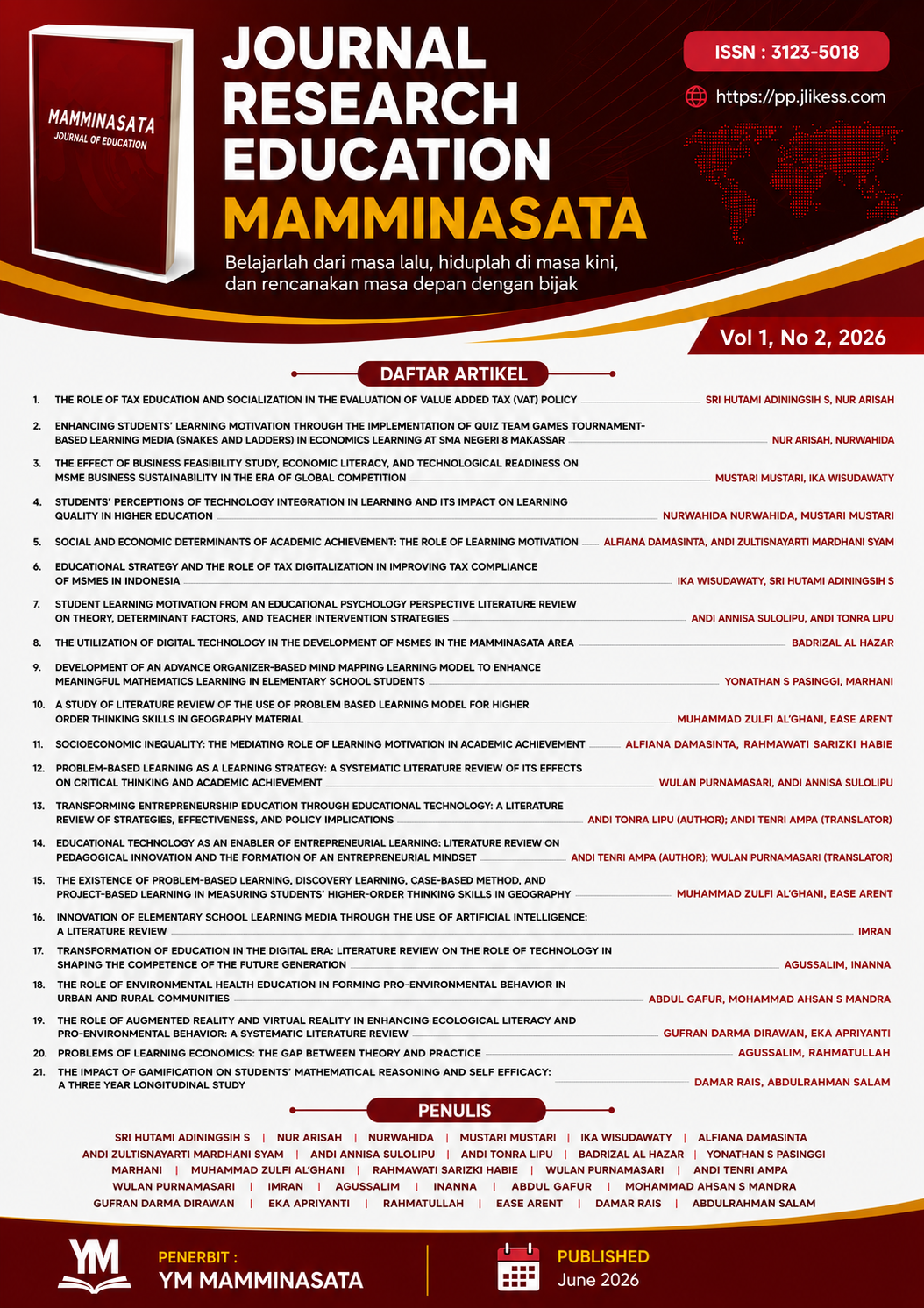
THE EFFECT OF BUSINESS FEASIBILITY STUDY, ECONOMIC LITERACY, AND TECHNOLOGICAL READINESS ON MSME BUSINESS SUSTAINABILITY IN THE ERA OF GLOBAL COMPETITION
DOI:
https://doi.org/10.66303/8yxj1s25Keywords:
Business Feasibility Study, Economic Literacy, Technological Readiness, Business SustainabilityAbstract
Purpose: This study aims to analyze the effect of business feasibility studies, economic literacy, and technological readiness on the business sustainability of Micro, Small, and Medium Enterprises (MSMEs) in Rappocini District, Makassar City. The background of this study is driven by global competition challenges that require MSMEs to possess adaptive capabilities, well-structured business planning, and effective utilization of digital technology.
Methods: This study employs a quantitative approach using Structural Equation Modeling–Partial Least Squares (SEM-PLS) and involves 223 MSME actors selected through purposive sampling. Data were collected using a Likert-scale questionnaire (1–4) and analyzed through outer model and inner model evaluation using SmartPLS.
Results: The results indicate that all three independent variables significantly affect business sustainability, with technological readiness being the most dominant factor, followed by business feasibility studies, while economic literacy shows a smaller yet still significant effect. The R-square value of 0.933 confirms that technological readiness, economic literacy, and business feasibility studies explain 93.3% of the variance in MSME business sustainability.
Conclusion: This study concludes that enhancing technology utilization, strengthening business feasibility analysis, and improving economic literacy are crucial strategies in promoting MSME sustainability in the era of global competition.
References
Al Ayyubi, S., Galuh, N., Utomo, B., Ayu, C., Dwiputra, F., & Suryanto, T. L. M. (2022). Analisis Penerimaan Ditlantas Jatim Digital Center Menggunakan Metode Technology Acceptance Model (TAM). Journal Of Information System And Artificial Intelligence, 3(1), 23–30. https://doi.org/10.26486/jisai.v3i1.83
Anggiat H Sihite. (2022). Analisis Perubahan Pola Konsumsi Masyarakat Dan Implikasinya Terhadap Sektor Perekonomian. Jurnal Price : Ekonomi Dan Akuntasi, 1(01), 36–46. https://doi.org/10.58471/jecoa.v1i01.3596
Arifin, A., & Kohar, K. (2022). Kesiapan Umkm Menghadapi Digitalisasi. Jurnal Ilmiah Ekonomi Manajemen Jurnal Ilmiah Multi Science, 13(1), 11–23. https://doi.org/10.52657/jiem.v13i1.1729
Artono, A., Yusup, M., Aziz, R. B., Sipayung, K. E., & Fayazza, W. (2025). Pelatihan Studi Kelayakan Bisnis dan Pembangunan Ekonomi Lokal: Studi Kasus di Cikarang Selatan. Lentera Pengabdian, 3(01), 93–100. https://doi.org/10.59422/lp.v3i01.703
Aryanti, A. & Aziza Riski Amanda. (2024). Upaya Pemberdayaan Potensi UMKM di Desa Batu Ampar Melalui Pengenalan dan Seminar Literasi Keuangan. Jurnal Pengabdian Masyarakat, 1(2), 7–14. https://doi.org/10.59963/2023.v1i2/315/5/juramas
Crismono, P. C., Abdillah, H., Musfiqurrohman, M., Hasanah, U., & Yuliandani, R. D. (2023). Menerapkan Theory Of Planned Behavior Untuk Memahami Dan Memprediksi Perilaku Berpikir Lateral:Intergrasi Kreativitas Dalam Psikologi Perilaku. Al-Ashr : Jurnal Pendidikan Dan Pembelajaran Dasar, 8(2), 105–115. https://doi.org/10.56013/alashr.v8i2.2945
Gomulia, B. (2013). Bisnis Keluarga di Bandung Bagaimana Mereka Bertahan-Berlanjut? TRIKONOMIKA, 12(2), 125–133. https://doi.org/10.23969/trikonomika.v12i2.474
Pramesthi, R. A., & Ariyantiningsih, F. (2022). Pengelolaan Kualitas Sumber Daya Manusia Melalui Peningkatan Literasi Mahasiswa Dalam Rangka Pengembangan Mutu Pendidikan Fakultas Ekonomi Dan Bisnis Universitas Abdurachman Saleh Situbondo. CERMIN: Jurnal Penelitian, 6(2), 584. https://doi.org/10.36841/cermin_unars.v6i2.2499
Prestian Ramadhan & Jhon Veri. (2025). Penerapan Sistem E-Commerce dan Teknologi Informasi dalam Meningkatkan Kewirausahaan Digital. JEKIN - Jurnal Teknik Informatika, 5(1), 171–180. https://doi.org/10.58794/jekin.v5i1.1109
Primanto, A. B., & Rahman, F. (2019). Perlukah Pendampingan Terhadap Pelaku Umkm Dalam Memanfaatkan Media Sosial Sebagai Saluran Pemasaran Strategis? Jurnal Manajemen Industri Dan Logistik, 3(2), 93–102. https://doi.org/10.30988/jmil.v3i02.146
Rengkung, L. R. (2015). Keuntungan Kompetitif Organisasi Dalam Perpsektif Resources Based View (RBV). AGRI-SOSIOEKONOMI, 11(2A), 1. https://doi.org/10.35791/agrsosek.11.2A.2015.9447
Rio Ferdinan Suryadi. (2024). Peran Umkm Dalam Mendorong Pertumbuhan Ekonomi Lokal Studi Kasus Di Indonesia. Journal Central Publisher, 1(9), 1096–1101. https://doi.org/10.60145/jcp.v1i9.207
Siburian, R., Anggraini, A., Sinurat, M. A., & Lubis, P. K. D. (2025). Analisis Aspek Studi Kelayakan Bisnis pada Usaha CV. Toma Baru. Journal of Law, Education and Business, 3(1), 47–57. https://doi.org/10.57235/jleb.v3i1.4790
Yushita, A. N. (2017). Pentingnya Literasi Keuangan Bagi Pengelolaan Keuangan Pribadi. Nominal, Barometer Riset Akuntansi Dan Manajemen, 6(1). https://doi.org/10.21831/nominal.v6i1.14330
Downloads
Published
Issue
Section
License
Copyright (c) 2026 Journal Research Education Mamminasata

This work is licensed under a Creative Commons Attribution-NonCommercial-ShareAlike 4.0 International License.