
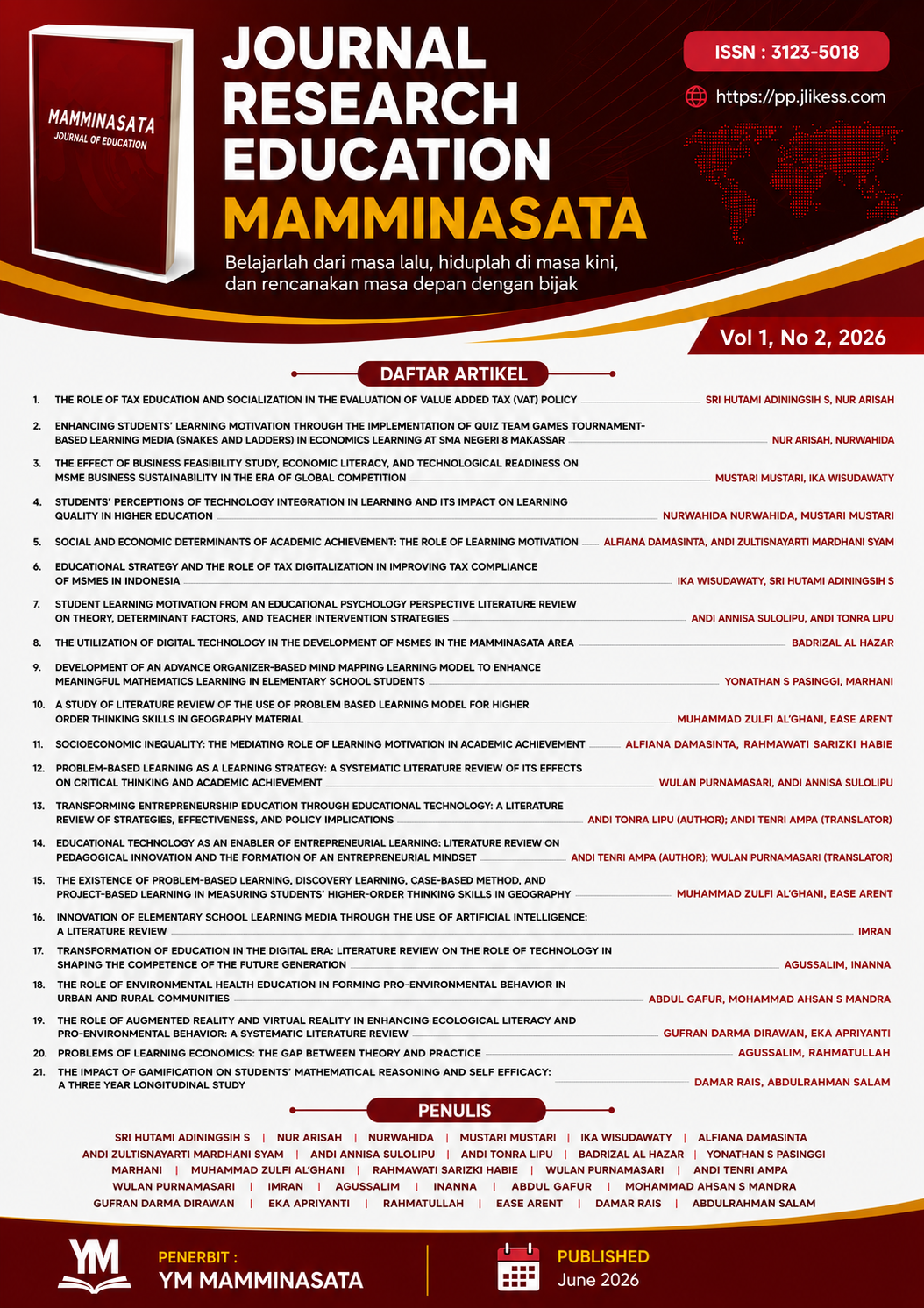
STUDENTS’ PERCEPTIONS OF TECHNOLOGY INTEGRATION IN LEARNING AND ITS IMPACT ON LEARNING QUALITY IN HIGHER EDUCATION
DOI:
https://doi.org/10.66303/xk8pzv46Keywords:
Technology Integration, Student Perception, Learning Quality, Higher EducationAbstract
Purpose: This study aims to analyze students’ perceptions of technology integration in higher education and its contribution to learning quality. The study is motivated by the increasing adoption of digital technologies in learning environments, which require a deeper understanding of how students experience and respond to technology-enhanced instruction.
Methods: This study employs a qualitative-dominant mixed-method approach. Data were collected through semi-structured interviews with three selected informants, classroom observations, and a supporting questionnaire involving 55 students selected through purposive sampling. Qualitative data were analyzed using thematic analysis, while quantitative data were analyzed descriptively to identify general trends in students’ perceptions.
Results: The findings indicate that students generally hold positive perceptions of technology integration, particularly in terms of flexibility, accessibility, and engagement. Technology enhances learning participation through interactive digital platforms, improves learning effectiveness by enabling access to multimodal and revisitable content, and fosters independent learning by encouraging self-directed study. However, challenges such as unequal access to digital resources and variations in lecturers’ technological competence were also identified.
Conclusion: This study concludes that technology integration contributes to learning quality through the interconnected dimensions of participation, effectiveness, and learner autonomy, provided that it is supported by appropriate infrastructure and aligned with pedagogical practices and students’ needs.
References
Al-Emran, M., Mezhuyev, V., & Kamaludin, A. (2023). Technology acceptance model in education: A systematic review. Education and Information Technologies, 28(2), 1205–1230. https://doi.org/10.1007/s10639-022-11130-7
Alturki, U., & Aldraiweesh, A. (2023). Integrated task-technology fit and self-determination theories in higher education: The role of actual use of MOOCs. Frontiers in Psychology, 14, 1108325. https://doi.org/10.3389/fpsyg.2023.1108325
Amiruddin, A., Sunardi, S., & Setialaksana, W. (2024). Students’ technological skills and attitudes toward HyFlex learning: The mediating role of online self-regulated learning, blended learning perception, and preferred learning modes. Frontiers in Education, 8, 1258298. https://doi.org/10.3389/feduc.2023.1258298
Cheng, X., Mo, W., & Duan, Y. (2023). Factors contributing to learning satisfaction with blended learning teaching mode among higher education students in China. Frontiers in Psychology, 14, 1193675. https://doi.org/10.3389/fpsyg.2023.1193675
Pandita, A., & Kiran, R. (2023). The technology interface and student engagement are significant stimuli in sustainable student satisfaction. Sustainability, 15(10), 7923. https://doi.org/10.3390/su15107923
Ryan, R. M., & Deci, E. L. (2020). Intrinsic motivation and self-determination in human behavior. Springer.
Sadegh-Zadeh, S.-A., Movahhedi, T., Hajiyavand, A. M., & Dearn, K. D. (2023). Exploring undergraduates’ perceptions of and engagement in an AI-enhanced online course. Frontiers in Education, 8, 1252543. https://doi.org/10.3389/feduc.2023.1252543
Schunk, D. H. (2020). Learning theories: An educational perspective (8th ed.). Pearson.
Sviridova, E., Yastrebova, E., Bakirova, G., & Rebrina, F. (2023). Immersive technologies as an innovative tool to increase academic success and motivation in higher education. Frontiers in Education, 8, 1192760. https://doi.org/10.3389/feduc.2023.1192760
Downloads
Published
Issue
Section
License
Copyright (c) 2026 Journal Research Education Mamminasata

This work is licensed under a Creative Commons Attribution-NonCommercial-ShareAlike 4.0 International License.