
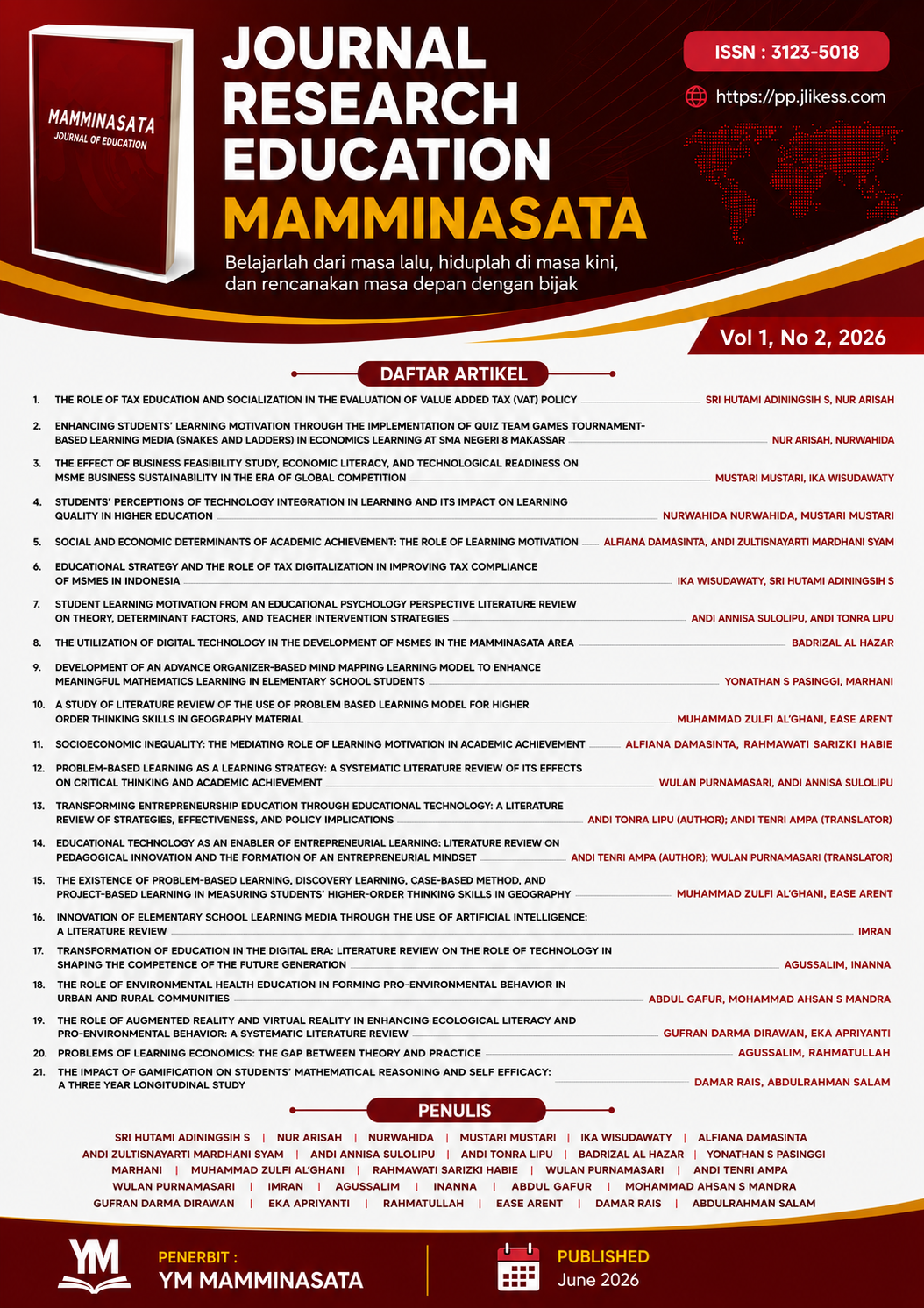
TRANSFORMING ENTREPRENEURSHIP EDUCATION THROUGH EDUCATIONAL TECHNOLOGY: A LITERATURE REVIEW OF STRATEGIES, EFFECTIVENESS, AND POLICY IMPLICATIONS
DOI:
https://doi.org/10.66303/4awdd816Keywords:
Entrepreneurship, Educational , Technology, Blended Learning, Policy implicationsAbstract
Background: The integration of educational technology (EdTech) in entrepreneurship education has grown significantly, yet systematic evidence on the effectiveness of various implementation strategies remains fragmented, particularly in developing country contexts. Purpose: This study aims to map EdTech implementation strategies in entrepreneurship education, evaluate their effectiveness based on empirical evidence, and formulate relevant policy implications. Methods:A systematic literature review (SLR) was conducted following PRISMA guidelines, searching four electronic databases — Scopus, Web of Science, ERIC, and Google Scholar — covering publications from 2013 to 2024. Of 1,247 articles identified, 48 met the inclusion criteria and were synthesized thematically. Results: Five dominant strategies were identified: e-learning and MOOCs (72.9%), blended learning (64.6%), digital business simulations and gamification (58.3%), virtual/augmented reality (29.2%), and AI-based adaptive learning (22.9%). Blended learning and simulation-based strategies consistently demonstrated the strongest effectiveness, particularly for cognitive and affective outcomes. Long-term behavioral outcomes were measured in only 25% of studies. Conclusion: EdTech integration positively impacts entrepreneurship learning outcomes, though evidence on actual entrepreneurial behavior remains limited, underscoring the need for evidence-based national policy standards.
References
1. Neck HM, Greene PG. Entrepreneurship education: known worlds and new frontiers. Journal of Small Business Management. 2011;49(1):55–70. https://doi.org/10.1111/j.1540-627X.2010.00314.x
2. Bosma N, Hill S, Ionescu-Somers A, Kelley D, Guerrero M, Schøtt T. Global Entrepreneurship Monitor 2020/2021 Global Report. London: GEM; 2021. https://doi.org/10.34667/tyne-xv62
3. Fayolle A, Liñán F. The future of research on entrepreneurial intentions. Journal of Business Research. 2014;67(5):663–6. https://doi.org/10.1016/j.jbusres.2013.11.024
4. Bates T. Teaching in a Digital Age: Guidelines for Designing Teaching and Learning. 2nd ed. Vancouver: Tony Bates Associates Ltd; 2019. https://doi.org/10.14288/1.0371850
5. Lorz M, Mueller S, Volery T. Entrepreneurship education: a systematic review of the methods in impact studies. Journal of Enterprising Culture. 2013;21(2):123–51. https://doi.org/10.1142/S0218495813500064
6. Nambiar D, Clarke M. Understanding the limitations of massive open online courses (MOOCs) for entrepreneurship education in developing countries. Education + Training. 2022;64(3):354–70. https://doi.org/10.1108/ET-04-2021-0132
7. Radianti J, Majchrzak TA, Fromm J, Wohlgenannt I. A systematic review of immersive virtual reality applications for higher education: design elements, lessons learned, and research agenda. Computers & Education. 2020;147:103778. https://doi.org/10.1016/j.compedu.2019.103778
8. Nabi G, Liñán F, Fayolle A, Krueger N, Walmsley A. The impact of entrepreneurship education in higher education: a systematic review and research agenda. Academy of Management Learning & Education. 2017;16(2):277–99. https://doi.org/10.5465/amle.2015.0026
9. van Laar E, van Deursen AJAM, van Dijk JAGM, de Haan J. The relation between 21st-century skills and digital skills: a systematic literature review. Computers in Human Behavior. 2017;72:577–88. https://doi.org/10.1016/j.chb.2017.03.010
10. Cope J. Toward a dynamic learning perspective of entrepreneurship. Entrepreneurship Theory and Practice. 2005;29(4):373–97. https://doi.org/10.1111/j.1540-6520.2005.00090.x
11. Page MJ, McKenzie JE, Bossuyt PM, Boutron I, Hoffmann TC, Mulrow CD, et al. The PRISMA 2020 statement: an updated guideline for reporting systematic reviews. BMJ. 2021;372:n71. https://doi.org/10.1136/bmj.n71
12. Tranfield D, Denyer D, Smart P. Towards a methodology for developing evidence‐informed management knowledge by means of systematic review. British Journal of Management. 2003;14(3):207–22. https://doi.org/10.1111/1467-8551.00375
13. Booth A, Sutton A, Papaioannou D. Systematic Approaches to a Successful Literature Review. 3rd ed. London: SAGE Publications; 2021. https://doi.org/10.4135/9781529626346
14. Liberati A, Altman DG, Tetzlaff J, Mulrow C, Gøtzsche PC, Ioannidis JPA, et al. The PRISMA statement for reporting systematic reviews and meta-analyses of studies that evaluate health care interventions. PLOS Medicine. 2009;6(7):e1000100. https://doi.org/10.1371/journal.pmed.1000100
15. Hong QN, Fàbregues S, Bartlett G, Boardman F, Cargo M, Dagenais P, et al. The Mixed Methods Appraisal Tool (MMAT) version 2018 for information professionals and researchers. Education for Information. 2018;34(4):285–91. https://doi.org/10.3233/EFI-180221
16. Pittaway L, Cope J. Entrepreneurship education: a systematic review of the evidence. International Small Business Journal. 2007;25(5):479–510. https://doi.org/10.1177/0266242607080656
17. Liñán F, Fayolle A. A systematic literature review on entrepreneurial intentions: citation, thematic analyses, and research agenda. International Entrepreneurship and Management Journal. 2015;11(4):907–33. https://doi.org/10.1007/s11365-015-0356-5
18. Jordan K, Weller M. Openness and education: a beginners' guide. Open Praxis. 2017;9(2):183–94. https://doi.org/10.5944/openpraxis.9.2.575
19. Neck HM, Corbett AC. The scholarship of teaching and learning entrepreneurship. Entrepreneurship Education and Pedagogy. 2018;1(1):8–41. https://doi.org/10.1177/2515127417737286
20. Dichev C, Dicheva D. Gamifying education: what is known, what is believed and what remains uncertain. International Journal of Educational Technology in Higher Education. 2017;14(1):9. https://doi.org/10.1186/s41239-017-0042-5
21. Merchant Z, Goetz ET, Cifuentes L, Keeney-Kennicutt W, Davis TJ. Effectiveness of virtual reality-based instruction on students' learning outcomes in K-12 and higher education. Computers & Education. 2014;70:29–40. https://doi.org/10.1016/j.compedu.2013.07.033
22. Zawacki-Richter O, Marín VI, Bond M, Gouverneur F. Systematic review of research on artificial intelligence applications in higher education. International Journal of Educational Technology in Higher Education. 2019;16(1):39. https://doi.org/10.1186/s41239-019-0171-0
23. Graham CR. Blended learning systems: definition, current trends, and future directions. In: Bonk CJ, Graham CR, editors. Handbook of Blended Learning. San Francisco: Pfeiffer; 2006. p. 3–21.
24. Martin F, Bolliger DU. Engagement matters: student perceptions on the importance of engagement strategies in the online learning environment. Online Learning. 2018;22(1):205–22. https://doi.org/10.24059/olj.v22i1.1092
25. Fayolle A, Liñán F, Moriano JA. Beyond entrepreneurial intentions: values and motivations in entrepreneurship. International Entrepreneurship and Management Journal. 2014;10(4):679–89. https://doi.org/10.1007/s11365-014-0306-7
26. von Graevenitz G, Harhoff D, Weber R. The effects of entrepreneurship education. Journal of Economic Behavior & Organization. 2010;76(1):90–112. https://doi.org/10.1016/j.jebo.2010.02.015
27. Means B, Toyama Y, Murphy R, Bakia M, Jones K. Evaluation of Evidence-Based Practices in Online Learning: A Meta-Analysis and Review of Online Learning Studies. Washington DC: U.S. Department of Education; 2010.
28. Tondeur J, van Braak J, Ertmer PA, Ottenbreit-Leftwich A. Understanding the relationship between teachers' pedagogical beliefs and technology use in education. Educational Technology Research and Development. 2017;65(3):555–75. https://doi.org/10.1007/s11423-016-9492-z
29. Ertmer PA, Ottenbreit-Leftwich AT. Teacher technology change: how knowledge, confidence, beliefs, and culture intersect. Journal of Research on Technology in Education. 2010;42(3):255–84. https://doi.org/10.1080/15391523.2010.10782551
30. Fayolle A. Personal views on the future of entrepreneurship education. Entrepreneurship & Regional Development. 2013;25(7–8):692–701. https://doi.org/10.1080/08985626.2013.821318
31. Audretsch DB, Kuratko DF, Link AN. Making sense of the elusive paradigm of entrepreneurship. Small Business Economics. 2016;45(4):703–12. https://doi.org/10.1007/s11187-015-9663-z
32. Kuratko DF. The emergence of entrepreneurship education: development, trends, and challenges. Entrepreneurship Theory and Practice. 2005;29(5):577–97. https://doi.org/10.1111/j.1540-6520.2005.00099.x
33. Rideout EC, Gray DO. Does entrepreneurship education really work? A review and methodological critique of the empirical literature on the effects of university-based entrepreneurship education. Journal of Small Business Management. 2013;51(3):329–51. https://doi.org/10.1111/jsbm.12021
34. Merrill MD. First principles of instruction. Educational Technology Research and Development. 2002;50(3):43–59. https://doi.org/10.1007/BF02505024
35. Morris MH, Kuratko DF, Pryor CG. Building blocks for the development of university-wide entrepreneurship. Entrepreneurship Research Journal. 2014;4(1):45–68. https://doi.org/10.1515/erj-2013-0047
Downloads
Published
Issue
Section
License
Copyright (c) 2026 Journal Research Education Mamminasata

This work is licensed under a Creative Commons Attribution-NonCommercial-ShareAlike 4.0 International License.