
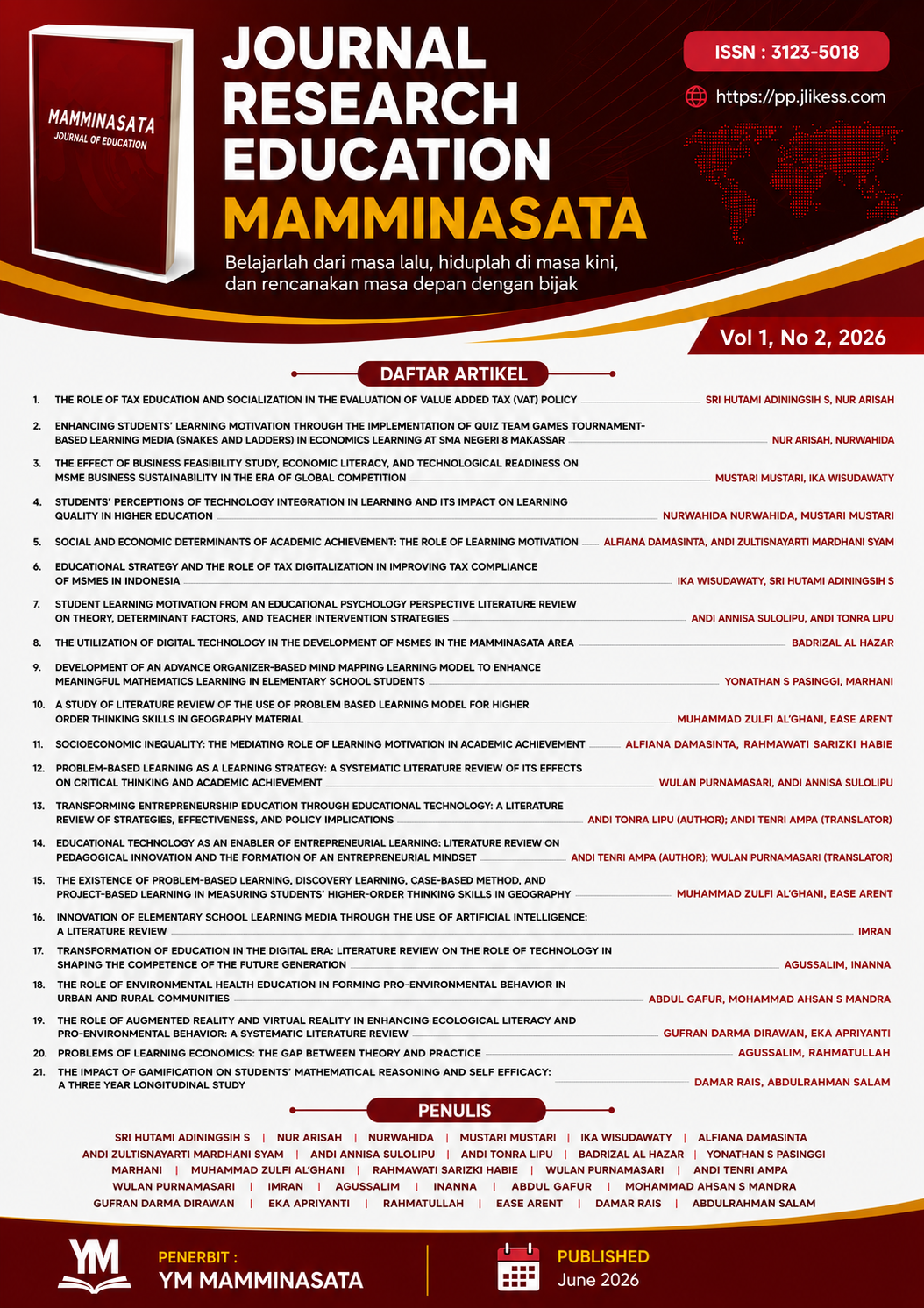
THE ROLE OF AUGMENTED REALITY AND VIRTUAL REALITY IN ENHANCING ECOLOGICAL LITERACY AND PRO-ENVIRONMENTAL BEHAVIOR: A SYSTEMATIC LITERATURE REVIEW
DOI:
https://doi.org/10.66303/7xrwd368Keywords:
Augmented Reality, Virtual Reality, Ecological Literacy, Enviromental Education, Pro Environmental BehaviorAbstract
Environmental problems such as climate change, pollution, ecosystem degradation, and biodiversity loss have become global challenges that require effective environmental education. The development of digital technology has provided new opportunities to improve learning through the use of Augmented Reality (AR) and Virtual Reality (VR). These technologies offer interactive and immersive learning experiences that can support the development of ecological literacy and pro-environmental behavior among learners. This study aims to examine the role of AR and VR in improving ecological literacy and pro-environmental behavior through a systematic literature review. The reviewed articles were collected from national and international publications published between 2020 and 2025. The results show that AR and VR have a positive impact on students’ understanding of environmental concepts, learning motivation, ecological awareness, environmental empathy, and pro-environmental behavior. Virtual Reality is commonly used for environmental simulations, climate change education, and ecosystem exploration, while Augmented Reality is widely used for visualizing environmental concepts and supporting interactive learning activities. However, several challenges remain, including limited infrastructure, high technology costs, and the need to improve teachers’ digital competencies. Overall, AR and VR have great potential to support innovative environmental education and promote sustainable behavior among learners.
References
Chen, B., Zhang, Y., & Li, H. (2025). Fostering learners’ environmental literacy through augmented reality and virtual reality. Proceedings of the International Conference of the Learning Sciences, 2532–2534.
Ditrich, L., Corner, A., & Whitmarsh, L. (2025). A front-row seat to catastrophe: Testing the effect of immersive technologies on climate change learning and pro-environmental behavior intentions. Environmental Education Research. Advance online publication.
Hajj-Hassan, M., Al-Samarraie, H., & Eldenfria, A. (2024). Environmental education: A systematic review on the use of digital tools for fostering sustainability awareness. Sustainability, 16(9), 3733. https://doi.org/10.3390/su16093733
Hurrell, C., Brown, M., & Smith, J. (2024). Virtual reality facilitates pro-environmental behavioural intentions through climate change experiences. Environmental Education Research, 30(8), 1124–1142. https://doi.org/10.1080/13504622.2024.2342942
Husamah, H., Pantiwati, Y., & Sumarsono, P. (2025). Integration of digital technologies in environmental education: Opportunities and challenges for sustainable learning. Varidika, 37(1), 45–58.
Kollmuss, A., & Agyeman, J. (2002). Mind the gap: Why do people act environmentally and what are the barriers to pro-environmental behavior? Environmental Education Research, 8(3), 239–260. https://doi.org/10.1080/13504620220145401
Koparan, B. (2025). Examining the impact of augmented reality texts on students’ attitudes toward environmental issues and sustainable development. Sustainability, 17(13), 6172.
Ladykova, T. I., Ivanova, E. V., & Petrova, A. N. (2024). Augmented reality in environmental education: A systematic review. European Journal of Mathematics and Science Technology Education, 20(5), em2419.
Mendoza, K. R., Van der Meer, J., & Peters, R. (2025). A systematic literature review on the impact of extended reality on pro-environmental knowledge, attitudes, and behaviors. Computers & Education Open, 7, 100215.
Orr, D. W. (1992). Ecological literacy: Education and the transition to a postmodern world. State University of New York Press.
Öztürk, E. (2023). Can environmental education supported by augmented reality improve students’ environmental knowledge, attitudes, and behaviors? Educational Policy Analysis and Strategic Research, 18(2), 112–128.
Ryan, R. M., & Deci, E. L. (2020). Intrinsic and extrinsic motivation from a self-determination theory perspective: Definitions, theory, practices, and future directions. Contemporary Educational Psychology, 61, 101860. https://doi.org/10.1016/j.cedpsych.2020.101860
Sahabuddin, E. S., Rahman, A., & Yusuf, M. (2024). Utilization of virtual reality as a learning tool to increase students’ pro-environmental behavior at higher education level. European Journal of Mathematics and Science Technology Education, 20(8), em2457.
Safitri, D., Hidayat, T., & Prasetyo, A. (2025). Transforming environmental education with augmented reality: Enhancing environmental awareness and learning outcomes. Heliyon, 11(4), e42015.
Simon, P. D., Zhong, Y., Dela Cruz, I. C., & Fryer, L. K. (2025). Scoping review of research on augmented reality in environmental education. Journal of Science Education and Technology, 34(4), 919–935. https://doi.org/10.1007/s10956-025-10218-z
Teh, C., Lim, K. S., & Abdullah, N. (2025). Eliciting pro-environmental behavior with immersive technologies: A review of recent evidence. Energy Research & Social Science, 122, 103997.
Xiong, S. R., Liu, Y., & Wang, H. (2024). Virtual environment, real impacts: A self-determination theory perspective on virtual reality and pro-environmental behavior. Local Environment, 29(7), 765–781. https://doi.org/10.1080/13549839.2024.2361270
Downloads
Published
Issue
Section
License
Copyright (c) 2026 Journal Research Education Mamminasata

This work is licensed under a Creative Commons Attribution-NonCommercial-ShareAlike 4.0 International License.